 Spain
Spain

Spain's two most popular long-stay routes are the Non-Lucrative Visa (NLV) and the Digital Nomad Visa (DNV), and the deciding factor is simple: do you need to work? The NLV is for retirees and the financially independent who will live in Spain without working; the DNV is for remote professionals earning mainly from companies or clients outside Spain. Both include your family and lead to long-term residence and eventual citizenship. Here's the side-by-side and how to choose.
At a glance: Non-Lucrative Visa vs Digital Nomad Visa
| Non-Lucrative Visa (NLV) | Digital Nomad Visa (DNV) | |
|---|---|---|
| Best for | Retirees & the financially independent | Remote workers & freelancers |
| Can you work? | No work allowed, including remote | Yes, remote work for non-Spanish companies/clients |
| Financial requirement | ~€2,400/mo means (400% of IPREM) | ~€2,442/mo income (200% of minimum wage) |
| Typical timeline | 2-4 months | 3-6 months |
| Where you apply | Spanish consulate abroad | Consulate (1-yr) or in Spain via the UGE (3-yr) |
| Special tax regime | No | Optional flat 24% regime (up to €600,000) |
| Path to citizenship | 5 yrs residence → 10 yrs citizenship | 5 yrs residence → 10 yrs citizenship |
| Family included | Yes | Yes |
Figures are 2026 guidelines for the main applicant (more is required per dependent). Citizenship is available after 10 years, or just 2 for nationals of Ibero-American countries, Andorra, the Philippines, Equatorial Guinea and Portugal.
The Non-Lucrative Visa: live in Spain on your own means
The NLV lets you live in Spain on sufficient financial means (pensions, investments or savings) without working locally. The 2026 reference is around €2,400 per month (400% of Spain's IPREM), plus full private health insurance with a Spanish-authorised provider. Crucially, it does not permit any gainful activity, including remote work. It's the classic route for retirees and the financially independent, and it processes quickly at 2-4 months. You should spend more than 183 days a year in Spain to keep it valid.

The Digital Nomad Visa: live in Spain while working remotely
The DNV is for remote employees and freelancers working mainly for non-Spanish companies or clients. You'll need around €2,442 per month (200% of the minimum wage), a relevant degree or 3+ years' experience, and proof of an established remote role. A standout feature is flexibility on where you apply: from abroad you get a one-year visa via the consulate, or from inside Spain you can apply through the UGE for a three-year authorisation, often decided in about 20 days. Many holders can also opt into a special 24% flat tax regime.

How to choose between the NLV and DNV
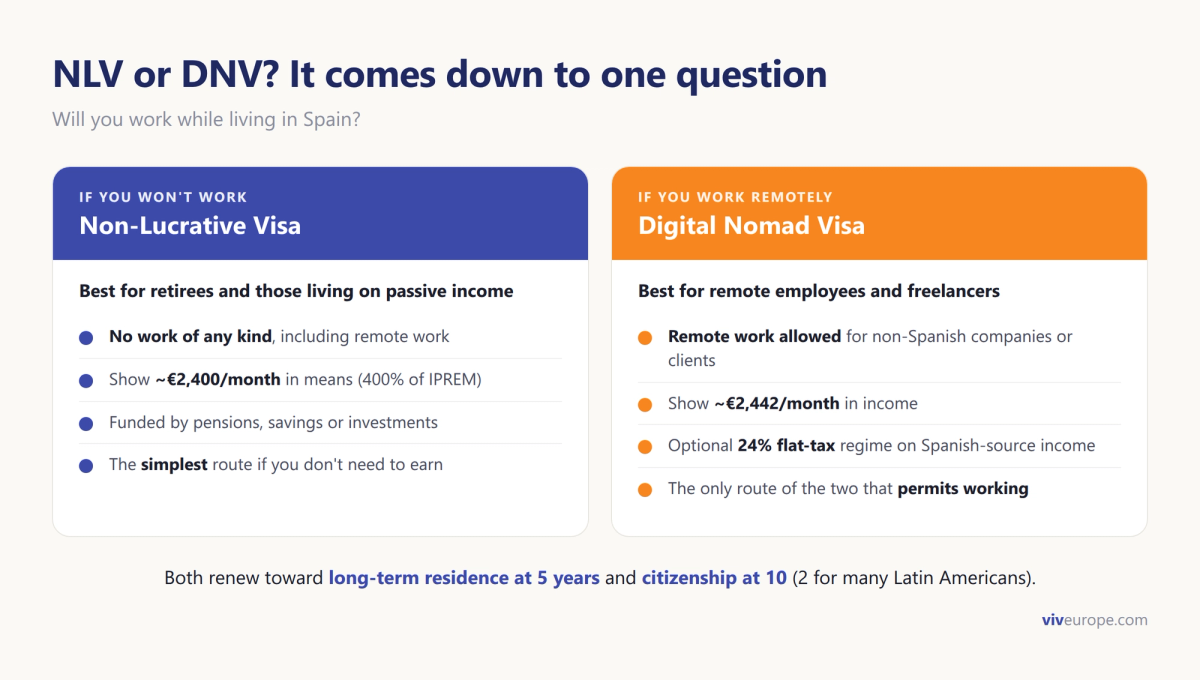
Choose the NLV if you won't work and want the simplest route
If you're retired or living on passive income and have no need to work, including remotely, the Non-Lucrative Visa is the most straightforward and fastest option.
Choose the DNV if you work remotely for clients or employers abroad
If you'll continue earning from a job or clients outside Spain, the DNV is the only one of the two that permits it. It also opens the door to the favourable flat-tax regime.
Frequently asked questions
Can I work remotely on Spain's Non-Lucrative Visa?
No. The Non-Lucrative Visa doesn't permit any gainful activity in Spain, and that includes remote work for a foreign employer. If you need to work remotely, the Digital Nomad Visa is the correct route.
Which Spain visa is faster to get?
The Non-Lucrative Visa is typically 2-4 months and the Digital Nomad Visa 3-6 months from a consulate. However, applying for the DNV from inside Spain through the UGE is often decided in about 20 days.
Is there a tax advantage to the Digital Nomad Visa?
Yes. Many DNV holders can opt into a special regime that taxes Spanish-source employment income at a flat 24% (up to €600,000) for up to five years, instead of the progressive rates. Confirm your eligibility with a tax adviser.
How much money do I need for each Spain visa?
The NLV needs roughly €2,400 per month of means (400% of IPREM); the DNV needs roughly €2,442 per month of income (200% of the minimum wage). Both require more for each dependent.
Do both visas lead to Spanish citizenship?
Yes. Both are renewable routes to long-term residence at five years and citizenship at ten, or just two years for nationals of Ibero-American countries, Andorra, the Philippines, Equatorial Guinea and Portugal.
NLV or DNV: which should I choose if I'm unsure?
If you're weighing early retirement against some remote income, the right route isn't always obvious. Viv Europe's team can confirm your eligibility and the strongest fit on a free assessment before you apply.