 Portugal

Every guide to moving to Portugal lists the same menu of visas. For most people it really comes down to two: the D7 and the D8. What almost none of those guides tell you is which one people actually choose, and how that has shifted over time.
We can answer part of that, because we have the applications.
This is a look at 493 visa processes we started between February 2021 and July 2026. It is not the whole Portuguese market. It is our own client base, and we will be specific about what that does and does not tell you.
The short version
Three patterns stand out across five years of applications:
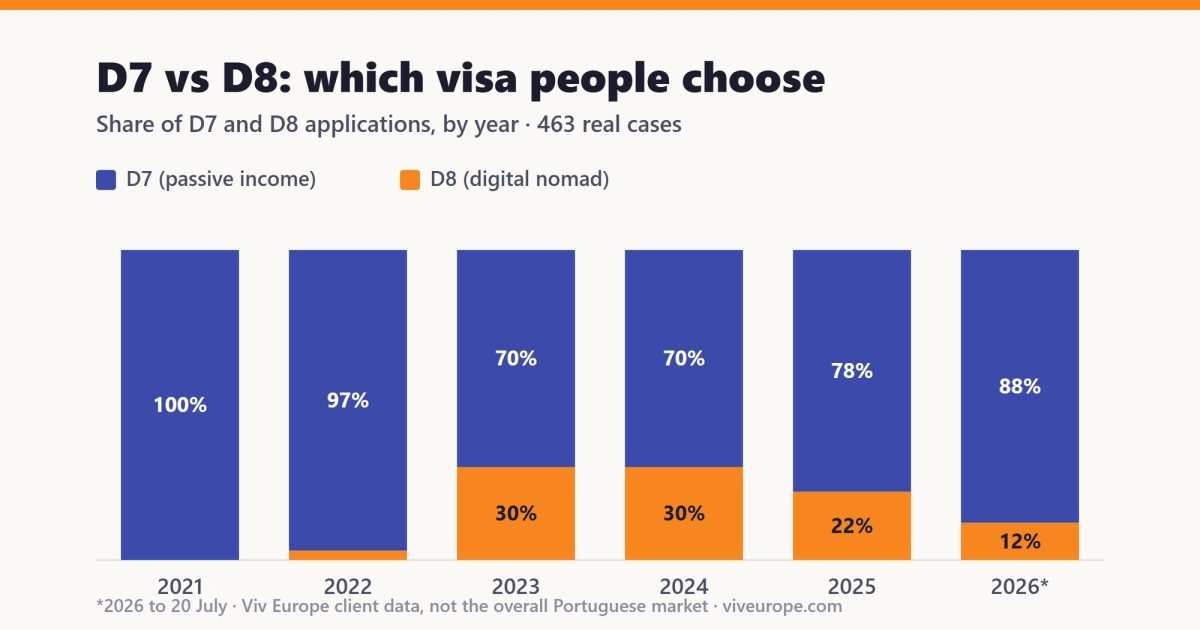
The D7 has been the backbone the entire time, never falling below 70% of the D7-versus-D8 split in any year. The D8 rose fast after it launched, reaching roughly 30% by 2023, then settled back. And, counter to what most people assume, the D8 is not faster than the D7: the median time to a consulate appointment is 160 days versus 155.
The D7 never stopped being the default
In 2021, every single application we handled was a D7. Not most of them. All of them.
Five years later it still takes the clear majority of the two. Its share of D7 and D8 applications has moved between 70% and 100%, and it has never been displaced.
| Year | D7 share | D8 share |
|---|---|---|
| 2021 | 100% | 0% |
| 2022 | 97% | 3% |
| 2023 | 70% | 30% |
| 2024 | 70% | 30% |
| 2025 | 78% | 22% |
| 2026 (to July) | 88% | 12% |
The reason is that the D7 visa fits the largest group of people who move: those with income that follows them. Pensions, rental income, dividends, royalties. It does not require you to invest, hire, or hold a particular kind of job. It asks whether you can support yourself.
That is a wide door, and it is why the D7 keeps winning.
The D8 arrived fast, then settled
Portugal's digital nomad visa (D8) opened in late 2022. Our first D8 application was in 2022. There is exactly one that year.
By 2023 it was nearly 30% of D7 and D8 applications.
That is a very fast adoption curve. It held near 30% through 2024, then eased to 22% in 2025 and 12% so far in 2026, though 2026 is a part-year with a small D8 sample.
The pattern is worth understanding. The D8 did not replace the D7. It captured a group who previously had no clean route: remote employees on a salary. Before the D8, those applicants tried to force themselves into a D7 by reframing salary as passive income, which is a poor fit. The D8 gave them their own door, and the people who needed it moved across quickly. Then it levelled off, because the population it serves is a defined size.
A new visa category tends to reveal demand that already existed rather than create new demand.
How long it takes to get a consulate appointment
One number people ask constantly and almost nobody answers with data: how long from deciding to move to actually sitting down at a consulate.
We can measure this, because we record when a process starts and when the first consulate appointment lands. Across 210 processes that reached an appointment:
| Visa | Applications measured | Median days to first appointment |
|---|---|---|
| D7 | 162 | 155 days |
| D8 | 48 | 160 days |

Roughly five months, and strikingly similar for both routes. Two things are worth drawing out.
The D8 is not faster than the D7. People often assume the newer, more modern digital nomad route moves quicker. In our data it does not. The medians are within a week of each other.
And the spread is enormous. The D7 range runs from nine days to over four years. That tail is the real story: the median tells you what to plan for, but appointment availability at your specific consulate matters more than which visa you picked. Applicants comparing visa types are usually optimising the wrong variable.
If you are building a timeline, five months to the appointment is a reasonable planning assumption, and the thing most likely to blow it up is consulate capacity rather than your paperwork.
What this means if you are choosing
The data does not tell you which visa is right for you. It does tell you something useful about the shape of the decision.
Most people are on the D7, and most people are on it for a good reason. If your income follows you and you intend to actually live in Portugal, the well-worn path is well-worn because it works.
If you are a salaried remote worker, the D8 exists specifically for you. A meaningful share of applicants spent 2021 and 2022 trying to fit that situation into a D7. You no longer have to.
The most common mistake we see is not picking the wrong visa. It is picking a visa before being honest about which of those two situations you are in.
Method and caveats
We looked at 493 visa processes started between 25 February 2021 and 20 July 2026, counted by the visa type each process was opened under and the year it began. Of those, 463 were a D7 or a D8; the D7-versus-D8 shares above are the split between just those two.
This is our client base, not the Portuguese market. It is a single firm's book. It is shaped by who finds us, which skews toward English-speaking and US-based applicants, and by which services we market most actively. A firm with different marketing would show a different mix.
2026 is a partial year, running to 20 July.
Appointment timings are measured from the date a process started with us to the first scheduled consulate appointment, across the 210 processes that reached one. We report medians rather than averages because the distribution has a long tail, and we cover only the D7 and D8 — other routes had too few cases to report responsibly.
These are applications and appointments, not outcomes. This article makes no claim about approval or refusal rates. Time to appointment is not the same as time to approval.