Last Updated on January 26, 2026 by Emily Hopkins
Make 2026 the year you transform your life. Welcome to our comprehensive guide to living in Portugal. Relocating to this southern European country can profoundly enhance your lifestyle and opportunities. With hundreds of thousands of people having successfully made the move, the question is: how can you get started?
This guide has been carefully researched and crafted to provide reliable, practical information, enabling you to make well-informed decisions about relocating to Portugal.
For those unfamiliar with Viv Europe, we provide professional assistance to individuals and businesses relocating to Portugal.
This guide offers essential information to help you gain a comprehensive understanding of Portugal. In addition, we provide practical tips designed to support a smooth and successful relocation experience. Tag along!
Table of Contents:
- Why Portugal?
- Authorization to Reside in Portugal
- Structure of Portugal
- Portuguese Government
- Taxes and Expenses
- Professional activity
- Business Activity
- Tax Information
- Healthcare
We published some relevant information that we consider useful for expats who intend to live in Portugal. This comprises general knowledge, culture, required documents, politics, finance, and the labor market.
First, each country has its own organizational rules. If you arrive in a new country, you must always adapt yourself to conform to the specifics of the environment.
Just one more thing before we start.
We believe in sharing knowledge. That’s why we created the Facebook Group – All About Portugal for Expats. Ask anything you want about this country, and we’ll try our best to answer everyone. Happy reading!
Part I
Why Portugal?
Portugal is a unique country with many distinguishing features, one of which is its strategic location. Situated in southwestern Europe on the Iberian Peninsula, Portugal covers approximately 92,000 km². It is bordered to the south and west by the Atlantic Ocean and to the north and east by Spain.
Some say that Portugal, along with Spain, Italy, and Greece, has the most pleasant climate on the European continent.
Portugal’s entire surface is located in the region classified as mild according to the Köppen-Geiger classification.
In practical terms, this means that the average temperature in Portugal is 16°C (60.8°F). Almost 18°C (64.4°F) in the south and 13°C (55.4°F) in the north of the country.
Portugal’s social and economic indicators reflect a high level of development, as evidenced by its Human Development Index (HDI) rating, according to the United Nations Development Programme (UNDP).
Finally, Portugal occupies the 40th position in the human development ranking.
Some additional interesting information about Portugal:
- The life expectancy of its inhabitants is 81.9 years, one of the longest in the world.
- It has one of the best Healthcare systems in the world.
- It is a member of the European Union (EU) and the United Nations (UN). And also of the North Atlantic Treaty Organization (NATO), and Organization for Economic Cooperation and Development (OECD).
Cost of living
Questions related to the cost of living in Portugal are quite common.
Even though Portugal is a small country in the territorial dimension, it has different living cost standards depending on the region under analysis.
The first rule is: the smaller the city’s structure (considering the circulation routes, number of healthcare centers, entertainment spots, etc.) and the further away from big urban cities, the lower the cost of living.
In some smaller cities in Portugal, regional activities are predominantly centered on agriculture, and the traditional way of life remains particularly pronounced. Notable examples include the municipalities of Cinfães, Tabuaço, and Celorico de Basto.
However, despite not having the structure of large cities, they are peaceful places where people usually know each neighbor.
- Want to check the list of all Portuguese cities, and it’s the respective population? Just click here.
These kinds of cities are perfect for those who want to escape the hustle and bustle of urban centers.
In this sense, Bragança is a perfect example of a city for those who seek this peaceful way of life.

- Read Also: Cost Of Living In Portugal Versus The USA.
Breakdown of cost of living
Portugal also has large urban centers, where corporations (and their qualified professionals), malls, and business centers are commonly located.
We all know these regions quite well, and we can highlight, among them, the cities of Lisbon, Porto, and Faro.
Although these regions differ significantly, Portugal exhibits a unique characteristic: with the exception of housing costs, daily expenses are relatively consistent across cities. Moreover, these costs are generally lower compared to those in the rest of Europe.
Thus, expenses for electricity, water, gas, central heating, television, internet, and food are very similar, regardless of the location.
At this point, we recommend reading the article “Complete Guide to the Real Estate Market in Portugal” for more information.
As for the distance between smaller cities and large urban centers, Portugal stands out for having three cities as reference located in strategic places:
Given Portugal’s relatively small size, any location chosen for settlement will be situated near one of the country’s major cities. For this reason, an increasing number of people are opting to live in smaller towns while remaining close to larger urban centers.
From this point of view, the cities of Braga, Setúbal, and Portimão stand out.
In relation to the city of Braga, we can consider the following approximate monthly costs, considering a couple’s situation:
| Expenses | Costs |
|---|---|
| Rent | €900 |
| Basic (Electricity, Heating, Cooling, Water, Garbage) for 85m2 Apartment | €170 |
| Internet | €36 |
| Mobile Phone Monthly Plan with Calls and 10GB+ Data | €19 |
| Groceries | €450 |
| Transport | €80 |
| Other expenses | €100 |
| Total | €1,755 |
Data is from Numbeo (as of January 2026).
Quality of life
Quality of life comprises attributes of a given location that contribute to a less-stressed lifestyle.
This includes the availability of essential “must-haves”, such as healthcare, a safe feeling, mobility options, and basic infrastructure.
For this subject, few countries are better qualified than Portugal.
When it comes to health, Portugal has an outstanding public healthcare structure, comprising local health posts and also public and private hospitals, aimed at serving its entire population.
For this reason, Portugal was one of the few countries in which healthcare did not collapse due to the situation of Covid-19.
It is also worth noting that expats can access public healthcare in Portugal upon obtaining their Utente Number, representing a significant advantage for those relocating to the country.
As for security, Portugal is the seventh-safest country in the world, according to the Global Peace Index 2025. As an example, France ranks 67th, Brazil 132nd, South Africa 130th, and the USA 131st.
Finally, in relation to mobility, Portugal was elected by the “Transport Assessment Panel” as the second European country with the best roads. Which has resulted, since 2010, in a reduction in the number of deaths resulting from traffic accidents.
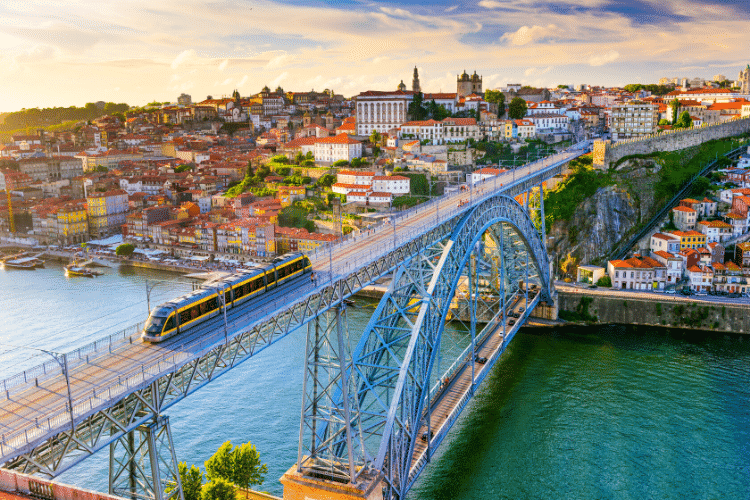
Public transportation should also be highlighted since Portugal has a railroad that crosses the entire country, from north to south.
As for the subway service, Lisbon and Porto have a well-structured underground transportation system.
In relation to buses, most cities are well equipped with affordable vehicles for commuting.
Portuguese Language
Fluency in Portuguese is a common concern for people from Anglophone and Francophone countries who intend to live in Portugal.
First of all, we have to keep in mind that Portuguese citizens have an excellent public education system, and English is taught in schools as an elementary course. That’s why English is commonly used in Portugal.
For those wishing to improve their Portuguese language skills, numerous accessible options are available, including popular free online courses.
Regarding the French language, it is worth noting that Portugal and France share a longstanding connection, resulting in frequent exchanges of citizens between the two countries, a trend that has continued to grow over time.
For this reason, there are some Portuguese cities where the French language is commonly spoken, mainly in the northern part of the country.
Currently, approximately 20,000 French people reside in Portugal, being the seventh-largest foreign community in this country, behind Brazil, Cape Green, Romania, Ukraine, the United Kingdom, and China.
However, French citizens are those who most acquired property in Portugal, then came the British, Brazilian, Swiss, and Chinese citizens.
Despite the availability of language resources, it is strongly recommended to acquire at least basic Portuguese proficiency before arriving in Portugal, as you are likely to encounter individuals particularly among the older population who communicate exclusively in Portuguese.
Also, you may need to sign documents (such as contracts and receipts), which are often written only in Portuguese.
Authorization to Reside in Portugal
Depending on the citizen’s country of origin, different types of activities must be done to enable regular residence in Portugal.
Let’s start our analysis with citizens nationals from countries outside of the European Union. For them, which include, for example, Brazilians, South Africans, and British, it will be necessary to apply for a visa.
Viv Europe has a Complete Guide on Visas for Portugal. In this document, you will check all the requirements to obtain a visa. Why not take a look?
For nationals of countries within the European Union, as well as Iceland, Liechtenstein, Norway, and Switzerland, the residency registration process in Portugal is simplified. In such cases, the sole requirement is to obtain the Certificate of Registration for European Citizens, which grants the right to reside in Portugal.
This document also authorizes expatriates to pursue education, engage in business activities, and work within the country.
Obviously, for each of these procedures (and depending on the citizen’s country of origin), it will be necessary to present specific forms and certificates, which is why we recommend the assistance of qualified professionals.
Part II
Structure of Portugal
About the Portuguese Government
Although this topic may appear less relevant for expats planning only to reside in Portugal, understanding the country’s administrative structure can assist in making informed decisions related to residence and long-term planning.
This subject takes on special importance for expats who intend to reside in Portugal for some reasons, among them:
- The possibility of understanding and monitoring the political decisions made by the government, especially those concerning the situation of immigrants; and
- Decision-making regarding the feasibility of residing in Portugal since the expat must comply with government guidelines.
We believe it is of great relevance to know, even if it’s just the tip of the iceberg, the characteristics of the country in which we intend to reside.
Also, knowledge about the country can be crucial in:
- Choosing a place of residence;
- Finding jobs;
- Making up a strategy to reduce the payment of fees and taxes.
Therefore, at this moment, we will carry out an analysis of the main aspects of the Portuguese power structure.
Executive Power (The “Two Heads” of State)
Portugal operates under a semi-presidential regime. This means power is split between two figures: the President of the Republic (Head of State) and the Prime Minister (Head of Government).
The President of the Republic
- Current Status (Jan 2026): Portugal is currently in a transition period. Marcelo Rebelo de Sousa is the outgoing president.
A highly contested election is underway, with a runoff scheduled for February 8, 2026, between António José Seguro and André Ventura.
- Role: The President is the “referee.” They do not run the country day-to-day, but they hold the “Atomic Bomb” of Portuguese politics: the power to dissolve Parliament and call new elections. They also command the Armed Forces and appoint the Prime Minister.
- Relevance to Expats: The President can veto immigration laws or send them to the Constitutional Court. The outcome of the 2026 election will signal whether Portugal remains open and progressive or shifts toward tighter nationalistic control.
The Prime Minister
Current PM: Luís Montenegro (Democratic Alliance – AD).
- Role: The Prime Minister holds the real executive power. He appoints ministers, manages the budget, and directs the agencies that handle your residency.
- Current Stability: The current government is a minority coalition. This means they must negotiate constantly to pass laws, leading to a dynamic (and sometimes unstable) legislative environment.
Legislative Power
The Assembly of the Republic is responsible for drafting and approving the laws applicable in Portugal.
This entire law procedure is carried out exclusively by the Assembly of the Republic precisely because the Legislative Branch is unicameral, without the presence of the Senate.
The Assembly of the Republic is made up of 230 deputies organized into parties.
Among them, we can highlight the following:
- Social Democratic Party (PSD)
- Socialist Party (PS)
- Popular Party (PP)
- Left Block (BE)
- Portuguese Communist Party (PCP)
- Ecologist Party (PEV)
- People-Animals-Nature (PAN)
Deputies represent geographic areas called electoral circles, which are currently divided into 22.
Each electoral circle has a specific number of seats in parliament, proportional to the number of voters in the region.
Similar to the President of the Republic, the Assembly of the Republic holds the authority to dismiss the government through a procedure known as a “Motion of Censorship“, which requires the approval of at least 116 of the 230 deputies.
Government Representation
In Portugal, the head of the Government is represented by the Prime Minister, who is appointed by the President of the Republic and is usually the leader of the party most voted in the legislative elections (but not necessarily).
As the head of the Executive Branch, the Prime Minister coordinates the activities of government ministers, represents the government, reports to the Assembly of the Republic, and keeps the President informed on matters of governance.
While the Prime Minister signs decrees, the formal promulgation of legislative acts remains the exclusive responsibility of the President.
Judiciary Power
Finally, the Judiciary Power, which is responsible, among other prerogatives, for adjudicating disputes related to individuals and the State itself and is represented by its public agents (judges).
It is an independent power whose members are distributed to act in Courts located throughout Portuguese territory.
According to the Constitution, the Courts are the sovereign bodies with the competence to manage justice in the name of the people.
This power emanates binding decisions for all public and private entities, prevailing over those of any other authorities.
There are currently 4 jurisdictions in Portugal, namely:
- Constitutional Jurisdiction (Constitutional Court)
- Common Jurisdiction (Judicial Courts)
- Administrative Jurisdiction (Administrative and Tax Courts)
- Financial Jurisdiction (Court of Auditors)
Portuguese Government
Current Government
Current Government
Portugal has recently experienced major political changes after snap legislative elections held in May 2025, and is now going through an important presidential transition.
President Marcelo Rebelo de Sousa is nearing the end of his second and final five-year term and cannot run again under the constitution.
Portugal is currently between the two rounds of its presidential election. The first round was held on January 18, 2026, but no candidate achieved the required majority.
Because of this, a second round of voting is scheduled for February 8, 2026. The runoff will be between António José Seguro, who received about 31 percent of the vote, and André Ventura, who gained around 24 percent.
At the government level, António Costa is no longer Prime Minister. The current Prime Minister is Luís Montenegro from the Social Democratic Party (PSD), who leads the XXV Constitutional Government.
After the May 2025 elections, he formed a minority center-right coalition called the Democratic Alliance (AD). Unlike the previous left-leaning setup, this government does not have an absolute majority in parliament.
This new political situation has brought stricter immigration policies and a stronger focus on budget and tax reforms. This makes it important for expats to stay informed about how these power shifts may affect residency and financial planning decisions.

Image | José Cruz – Agência Brasil | Wikimedia Commons
Part III
Taxes and Expenses
We will now analyze the Portuguese Tax System.
Let’s analyze the tax obligations of citizens who decide to reside, work or undertake in Portugal.
Portugal is a country recognized for its attractive tax conditions for expats.
We will carry out the analysis of the main program to attract professionals and investments to Portugal for the benefit of the citizen who intends to reside in this country: The Non-Habitual Resident Tax Regime 2.0.
Then, let’s focus on the taxes and expenses that affect the payroll of an employee in Portugal, and finally, we will talk about the situation of the entrepreneur in this country.
If you want to check our answers to the most popular tax-related questions, check our FAQ by clicking here.
The Non-Habitual Resident regime
Portugal previously offered the Non-Habitual Resident (NHR) regime as a way to attract foreign professionals and pensioners. This regime is now closed to new applicants.
It has been replaced by a new incentive called the Incentive for Scientific Research and Innovation, better referred to as NHR 2.0.
This program is designed to attract highly qualified professionals working in areas such as research, technology, and innovation.
Under this new system, eligible professionals may benefit from a reduced personal income tax rate on employment or professional income earned in Portugal.
Unlike the old regime, this incentive is limited to specific activities linked to innovation and scientific development and does not automatically apply to retirees.
To qualify, you must not have been a Portuguese tax resident in the previous five years and must meet the legal criteria linked to their profession and employer. The benefit period can last up to ten years if all conditions continue to be met.
Costs arising from the exercise of activities
Now, let’s move on to the analysis of the taxes that are levied on income resulting from the exercise of professional activity and also on the expenses resulting from developing a business activity in Portugal.
Professional activity
Usually, if an expat works as an employee in Portugal, he/she must pay taxes under the same conditions as a Portuguese citizen.
In this case, the following taxes will be due:
Personal Income Tax (IRS)
This is the tax on the worker’s income.
It must be paid annually and corresponds to the revenue received by the employee during this period.

In general, a foreign worker in Portugal is taxed under the same rules as a Portuguese citizen. The main tax applied to employment income is Personal Income Tax (IRS). IRS is calculated using progressive tax brackets, meaning higher income is taxed at higher rates.
The applicable rates and thresholds are updated regularly by the government, so exact figures change from year to year. The final tax paid depends on income level, marital status, number of dependents, and eligible deductions.
In addition to income tax, employees must contribute to Social Security. The employee’s contribution is normally 11 percent of gross salary, while the employer pays approximately 23.75 percent.
Indirect Taxes
In addition to the IRS, the citizen must also pay indirect taxes directly levied on the goods and services he consumes on a daily basis.
This value is already part of the final price paid by the consumer.
We’re talking about the famous Value Added Tax (VAT) levied on consumer goods, which is paid whenever the citizen purchases food products in markets, electronic products in stores, when carrying out a medical consultation, etc.
The rate of this tax changes depending on the type of product or service consumed.
In mainland Portugal, the following rates are in force:
- Reduced rate – 6%
- Intermediate rate – 13%
- Normal rate – 23%
Other Taxes
Portugal has other types of taxes.
Among them, we can highlight those related to the acquisition and maintenance of properties, motor vehicles, and alcoholic beverages, among others.
Business Activity
Let’s now focus our attention on the costs incurred in developing the business activity.
An expat who plans to develop any business activity in Portugal must consider some expenses.
Among the main expenses, we can highlight the following:
Employees
Employee-related costs, including payroll, typically represent a company’s primary expenditures. In Portugal, employees receive a total of 14 monthly salaries per year. In addition to the salary, employers are responsible for contributing 23% of the employee’s Social Security payments, while employees contribute the remaining 11%.
Payment by the employer of accident insurance is mandatory and falls on 1% of the employee’s salary. The food contribution will range from around €6 per workday.
Thus, considering an employee who receives a gross monthly salary of €1,200, his annual salary (plus insurance and food) will correspond to €22,409, and his effective monthly cost to the company will be around €1,867.
Other Expenses
Obviously, in addition to employee expenses, the employer must spend the required costs for the development of the activity. Among them, we can highlight the following:
- Acquisition of material
- Logistics
- Acquisition or lease of property
- Hiring an accounting service
- Hiring service providers
- Payment of registration fees
- Purchase of machinery
- Marketing activities, among others
Corporate Income Tax (IRC)
Finally, the IRC is the most important tax levied on income resulting from the exercise of business activity.
The Corporate Income Tax (IRC) applies to the company’s taxable amount, which is calculated as the difference between total income and total expenses over a given period. For most companies, the standard IRC rate is 21%.
Also, in most municipalities, the municipal surcharge in the amount of 1.5% must be included, levied on the taxable amounts.
The analysis of the company tax must be carried out by a qualified accounting professional, given the complexity and responsibilities arising from this function.
Tax Information
We will discuss in this topic the main activities that the expat must carry out as soon as he/she moves to Portugal.
These activities are divided into:
- Legal obligations that must be performed under penalty of non-compliance with a legal duty, or
- Advice, that is, activities that are not mandatory but recommended so that the expatriate citizen will not have financial losses.
It is important to note that failure to comply with these obligations may result in administrative sanctions, including fines or, in severe cases, the deportation of individuals residing in Portugal irregularly.
Depending on the circumstances of an individual’s relocation to Portugal, additional obligations may also arise.
We will only deal with some important activities that an expat needs to carry out.
Tax Identification
The Tax Identification Number (NIF) is undoubtedly one of the most important Portuguese identification documents and can be required by the Finance department.
This document is required for tax identification purposes. Only by having this number will the citizen be able to declare his taxes.
Also, whenever a citizen carries out commercial transactions in Portugal, he/she may inform the NIF number for deductions on his / her Income Tax (IRS).
In this way, the more the person consumes, the more he/she will be able to deduct tax amounts. Therefore, we recommend always mentioning this number when purchasing goods or services in Portugal.
The Número de Identificação Fiscal (NIF) is required for a variety of daily activities in Portugal, including renting or purchasing property, opening a bank account, signing an employment contract, or enrolling in a Portuguese university.
To obtain a NIF, individuals must present the following documents:
- Passport
- Proof of address in Portugal
- Signed requirement
If the citizen does not have a property in Portugal, whether rented or owned, he/she will need to indicate a person to represent him/her for tax-related subjects in order to request the NIF.
This representative, who must have an established residence in Portugal, will receive all correspondence regarding the tax situation of the represented citizen.
After the expat settles permanently in Portugal, he/she can request the NIF update to cease the representation.
Declaration of Departure from the Country of Origin
Continuing with the discussion of tax obligations, it is important to consider the Declaration of Definitive Departure from the country of origin.
This declaration involves notifying the tax authorities in the country of origin about the change of residence and, consequently, the relocation of the individual’s tax domicile.
In this sense, it is important to highlight that each country has its own regulations for this procedure.
It is up to the taxpayer to choose the address that will be appointed as the tax domicile. Based on this decision, the country that will collect the citizen’s taxes will be selected.
In this sense, depending on the country of origin and of the residence, different procedures and obligations may apply, especially due to agreements signed between countries.
It is important to note that numerous international agreements currently exist to prevent double taxation.
These agreements are particularly significant for expatriates who may continue to receive income from their country of origin.
The most common income in this regard is as follows:
- Rental income
- Receipt of dividends
- Performance in the stock market
- Retirement
As a rule, the existence of an agreement to avoid double taxation between countries requires the expat citizen to perform the declaration and the payment of income tax in the country of residence, usually declared as a tax domicile.
For this reason, Portugal has been a very popular country in terms of residence by European citizens, especially as a result of the tax incentives granted to expats who meet certain requirements.
Social Security
In Portugal, citizens can register for Social Security and receive the NISS: the Social Security Identification Number.
All workers who wish to work and live in Portugal need to have a NISS.
The worker receives his salary already discounted from the Social Security payment share, which corresponds, in most cases, to 11% of the salary.
After the registration and payment of social security funds, the worker may receive (if they meet the requirements) retirement income and also those resulting from parental leave, sick leave, and unemployment benefits, among others.
To obtain a Número de Identificação da Segurança Social (NISS), it is necessary to provide an employment promise or contract.
It is important to note that the employer is responsible for notifying Social Security of the employee’s hiring, after which the employee’s NISS will be generated.
This is an obligation for the employer to hire an employee; for this reason, many of them do not accept applications for employment from citizens who do not have an active NISS.
In the case of self-employed individuals, the NISS must be obtained directly from Social Security, with proof of services rendered provided through Green Receipts.
In addition to the Employment Promise or Contract, the applicant must submit the following documents for the purpose of obtaining a NISS (if he/she) is not a European citizen:
- Valid Passport with legal entry stamp in Europe
- NIF
- Residence permit (with work permit)
- Mod RV 1006 -DGSS form completed
If the citizen is European, he/she must present the documents numbered 2 and 4.
Finally, a quick note. Since 2019, the legislation related to retirement in Portugal has changed.
Nowadays, for retirement reasons, the citizen must have at least 66 years and 5 months and a minimum contribution time of 15 years for both men and women.
Part IV
Additional Topics
To conclude this article, let’s analyze some complementary topics that we believe are relevant for the expat who intends to reside in Portugal.
Portuguese Health System
Let’s now talk about the Portuguese Public Health system, which is essential if you’re planning to live in Portugal.
Expats in Portugal may also seek care at private clinics, where consultation fees typically range from €30 to €60. In contrast, public healthcare has been free for all legal residents since June 2022.
To access the public health system, expatriates must obtain a Utente Number.
After obtaining this document, he/she will be addressed to a Family Doctor who will be his / her general practitioner.
To obtain the Utente Number, you will need to go to a Health Center and present the following documents:
- Passport
- NIF
If you are a European citizen, your path is simplified, as there are international treaties that allow access to Public Health among countries that are members of the European Union.
As an example, a French citizen may have access to public health from European countries by presenting a carte européenne d’assurance maladie, which you can get by filling in the Formulaire S1.
In any case, if a French citizen is registered with Portugal’s Social Security system, they may also obtain a Utente Number and be assigned a primary care physician.
Conclusion
This concludes our guide, designed to provide a comprehensive overview of living in Portugal.
We hope that this information was useful and that it helped to broaden your knowledge about this very special country.
If you have any questions, want to share your opinion, or know more information, join our Facebook Group or contact professionals from Viv Europe.